The Architecture of Modern Privacy Governance: Transitioning from Policy to Engineering Reality

After more than a decade of implementing governance, risk, cybersecurity, privacy, quality, and compliance programs across government, banking, healthcare, pharmaceuticals, cloud service providers, and emerging AI environments, one fundamental truth becomes clear: governance is widely misunderstood.
As organizations rush to adopt cloud infrastructure, generative AI, and autonomous agentic systems, privacy can no longer survive as a static, bureaucratic checking of boxes. It must evolve into Privacy by Design—an enterprise-wide system of continuous accountability embedded directly into the engineering lifecycle.
Redefining Governance: Who Actually Owns the Risk?
A common misconception in corporate culture is that specialized executives own organizational risk. We often hear that the Chief Information Security Officer (CISO) owns cyber risk or the Chief Risk Officer (CRO) owns privacy risk. In practice, this is a dangerous misalignment.
Governance is not owned by the CISO, the CRO, or even solely by the Board of Directors. Rather, governance is a system of accountability that operates throughout the entire enterprise.
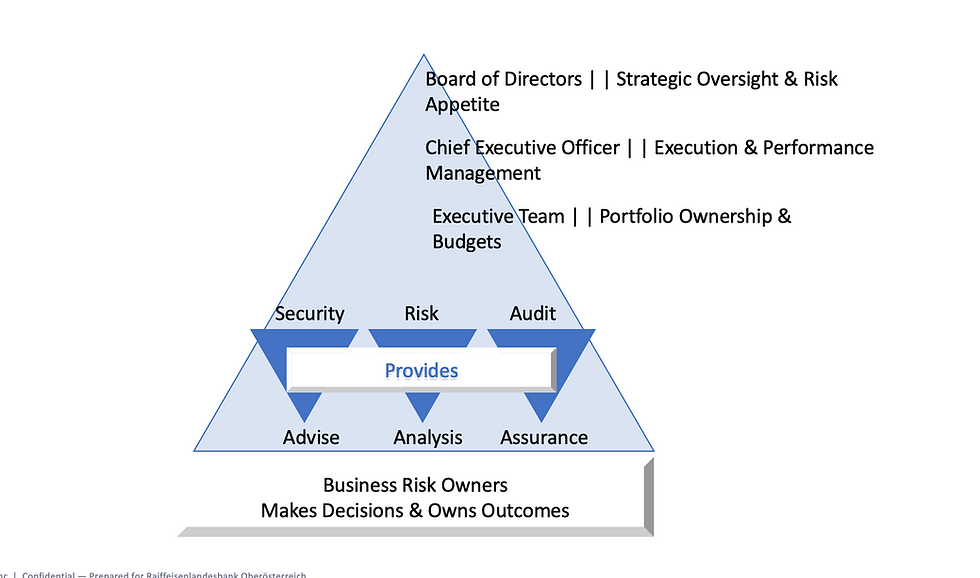
To operationalize governance effectively, we must separate roles clearly:
The Board of Directors provides strategic oversight, approves corporate objectives, establishes risk tolerance, and approves major budgets. They look at the horizon, but they do not run the day-to-day business.
The CEO is accountable for executing that approved strategy, building the executive leadership team, and delegating authority across portfolios (CFO, CIO, CLO, CISO, etc.).
The Executive Team and Business Leaders own the actual business plans, staffing, technology adoption, and associated risks.
Ultimately, the business owns the business risk, while security provides advice, risk provides analysis, and audit provides assurance. True governance belongs to those who own the consequences of the decisions.
The Velocity Vector: Governance in the Age of AI and Cloud
We frequently confuse governance ownership with decision ownership. Governance defines the rules of the game—the objectives, risk appetite, and escalation paths. But decisions are made at the ground level by people closest to the work.
Cloud computing and Artificial Intelligence haven't changed who owns governance; they have changed the speed and distribution of decision-making.
Decisions that once took months now occur in days, hours, or milliseconds via automated algorithms. Governance cannot remain an annual, retrospective exercise. The true test of modern privacy governance is whether it enables thousands of everyday, distributed engineering decisions to align with enterprise intent, even when no steering committee is in the room.
3 Critical Gaps in Contemporary Privacy Engineering
When transitioning from high-level privacy policies to technical execution, modern practitioners face three systemic friction points:
1. Data Minimization in AI Pipelines
Models trained on vast repositories of historical data often carry significantly more Personally Identifiable Information (PII) than necessary. Enforcing strict data minimization principles becomes incredibly difficult when data lineage is opaque and machine learning training sets are inherited rather than purpose-built for a discrete objective.
2. Consent in Agentic Systems
Traditional privacy frameworks operate on a simple assumption: a human initiating a discrete, linear transaction. When autonomous AI agents begin acting on behalf of users—interacting across multiple external systems, chains of APIs, and microservices—the traditional consent chain breaks entirely. Tracking who owns, validates, and propagates that consent across an asynchronous workflow is an unsolved hurdle for many enterprises.
3. Cross-Border Data Flows and Regulatory Fragmentation
The regulatory landscape is fracturing faster than most privacy offices can track, driven by the divergence of the GDPR, CPRA, and localized state or national frameworks. A major systemic vulnerability occurs because data residency decisions are frequently made at the infrastructure level (by cloud engineers optimizing for latency or cost), completely disconnected from the legal and compliance obligations sitting above them.
Closing the Gap: From Policy to Engineering Reality
To survive regulatory fragmentation and technical acceleration, privacy governance must mirror the shift happening across broader corporate governance: moving from periodic reviews to continuous, embedded technical control.
Practitioners are actively closing the gap between policy and engineering reality through three actionable strategies:
Architectural Automation
Privacy cannot be an afterthought audited at the end of a sprint. Privacy requirements must be translated into explicit technical requirements—such as automated data masking, tokenization at the ingestion layer, and automated data retention scripts.
Data Lineage Mapping
To combat the opacity of AI pipelines, mature engineering teams are implementing automated data cataloging and lineage tools. By tagging data at the point of origin with metadata regarding its purpose, allowed usage, and retention limits, the system can dynamically prevent unauthorized data from bleeding into downstream model training sets.
Shifting Privacy Left
Just as "DevSecOps" integrated security into the continuous integration and continuous deployment (CI/CD) pipeline, privacy must also "shift left." This means building automated compliance checks, regional data boundary validations, and consent propagation checks directly into code repositories and deployment pipelines.
Summary
Governance is not a static framework, a siloed department, or a committee meeting; it is an enterprise-wide system of accountability connecting strategy, execution, performance, and continual improvement. By treating privacy as a continuous systemic capability rather than a bureaucratic hurdle, organizations can confidently innovate through AI and cloud architectures without breaking consumer trust or regulatory boundaries.
Comments